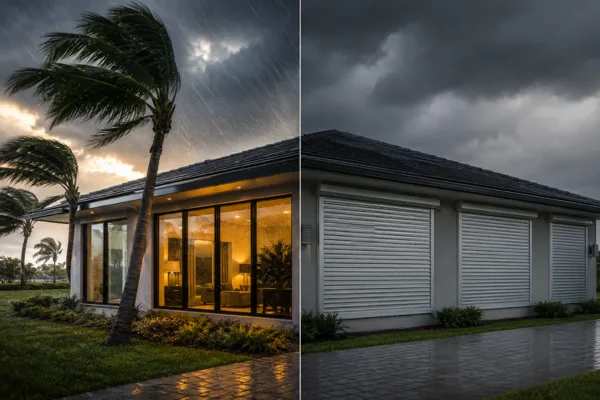
Impact Windows vs Hurricane Shutters: Which Is Better
A Category 4 hurricane is 12 hours away. You are stuck at the airport three states over. Your windows have no protection. That is the nightmare thousands of Florida homeowners face every single year when comparing impact windows vs hurricane shutters.
Impact windows are permanently installed, hurricane-rated windows made with laminated glass and a polymer interlayer that holds together even when cracked. Hurricane shutters are removable or deployable coverings that must be manually secured over windows and doors before every storm.
With hurricane season running June through November, this decision affects your home's safety, your insurance premiums, and your daily quality of life for years to come.
At G&R Doors, Windows & Roofing, we install locally manufactured impact-resistant windows across Miami-Dade, Broward, and Palm Beach counties, with $0 down financing and a 5-year parts and labour warranty.
In this blog, we will compare both options across cost, protection, insurance savings, convenience, and long-term value so you can make the right call for your Florida home.
What Are Impact Windows and How Do They Work?
From the outside, impact windows look like any other window. Same styles. Same sizes. Same clean lines. But the engineering inside is completely different.
An impact window uses two panes of glass bonded together with a tough polymer interlayer, usually polyvinyl butyral (PVB) or ethylene-vinyl acetate (EVA). That interlayer is the key. When debris strikes the glass during a hurricane, the outer pane may crack, but the interlayer holds everything in place. No shards flying into your living room. No sudden pressure change that can blow off your roof from the inside.
The frame matters too. Impact windows sit inside reinforced aluminium or vinyl frames designed to resist bending under extreme wind pressure. Our impact-resistant windows can withstand hurricane-force winds up to 200 mph. That is Category 5 territory.
And here is the part most homeowners care about most. You install them once. After that, they protect your home 24 hours a day, 365 days a year. No boards to put up. No panels to drag out of the garage. No frantic phone calls to a neighbour asking them to secure your house because you are stuck out of town. The protection is built in, permanently.
They also block up to 99% of UV rays, reduce outside noise, and improve energy efficiency. But we will get into those benefits in detail later.
What Are Hurricane Shutters and How Do They Work?
Hurricane shutters are protective barriers that cover your windows and doors from the outside. They block wind, rain, and flying debris from reaching the glass underneath.
The concept is simple. Before a storm hits, you close the shutters. After the storm passes, you open them again. Between storms, most types stay folded, rolled, or stored away.
Five main types exist, and each works differently.
Accordion shutters fold flat against the sides of your windows and unfold on a track to cover the opening. Rolling shutters sit in a box above the window and roll down when needed, either manually or with a motor. Storm panels are removable aluminium or steel sheets that bolt into tracks around the window frame. Bahama shutters mount above the window and prop open at an angle, giving your home a tropical look while staying ready to close. Colonial shutters are hinged on both sides of the window and swing shut.
Prices vary widely by type. Accordion and rolling shutters cost more but deploy faster. Storm panels are the cheapest option but take the longest to install and require storage space for the panels.
The biggest trade-off? Every single type requires manual action before every single storm. If nobody is home to close them, your windows are exposed.
Impact Windows vs Hurricane Shutters: Side-by-Side Cost Comparison
Money drives most decisions. So let us put real numbers on the table.
Upfront Cost: Hurricane Shutters Are Cheaper
There is no way around this. Hurricane shutters cost less on day one.
For a typical Florida home, hurricane shutter installation runs between $1,500 and $5,900 depending on the type, the number of openings, and the home's layout. Storm panels sit at the low end. Rolling shutters push toward the top.
Impact windows cost $500 to $1,200 per window installed. For a full home, that adds up to $4,250 to $19,850 depending on how many windows you have, the sizes, and the frame material you choose. A home with 15 windows will obviously cost more than a condo with six.
On price alone, shutters win. No debate there.
Long-Term Cost: Impact Windows Pay for Themselves
But the sticker price only tells part of the story.
Think about what happens after installation. With hurricane shutters, you still have your original windows. Those windows do nothing for your energy bills. They do nothing for your insurance premium. And when they reach the end of their lifespan (20-30 years in Florida's heat), you replace them separately. That is another $3,000 to $10,000 down the road.
Impact windows replace your old windows entirely. You get storm protection AND new, energy-efficient windows in one project.
Then there is insurance. According to the Florida Department of Financial Services, homeowners with approved wind mitigation upgrades can save 10-45% on windstorm premiums. For many South Florida homeowners, that translates to $1,000 to $3,000 per year. Run that math over 10 years. The impact windows are paying for themselves while the shutters are rusting in the garage.
Energy savings add to the equation too. Laminated glass with reinforced frames reduces heat transfer, which means your AC runs less during South Florida's brutal summers. Shutters provide zero energy benefit when they are open, which is 99% of the time.
Most homeowners who choose impact windows recover their full investment within 5 to 8 years through combined insurance and energy savings. After that, it is pure savings.
Hurricane Protection: Which Option Is Safer During a Storm?
Both options meet Florida Building Code requirements for hurricane protection when properly installed. Both block windborne debris. Both protect your glass from shattering inward.
But they protect your home in very different ways.
Impact windows absorb the hit. When a tree branch or a piece of roofing tile slams into the glass at 130 mph, the outer pane cracks but the polymer interlayer holds the glass together. No breach. No pressure change inside the home. Wind and rain stay outside. Your roof stays on. That interlayer is the reason impact windows can handle sustained winds up to 200 mph.
Hurricane shutters deflect the hit. The metal barrier takes the impact instead of the glass. Aluminium and steel panels absorb and distribute the force across the shutter surface. When properly secured, shutters hold up well in most hurricanes.
The key phrase there is "when properly secured."
Storm panels that are not bolted into every fastener point can loosen. Accordion shutters with worn tracks can jam halfway. Rolling shutters with neglected motors can fail at the worst possible moment. Maintenance matters, and not every homeowner keeps up with it.
What Happens If You Are Not Home When a Storm Hits?
Picture this. You are visiting family in New York. A tropical storm forms in the Caribbean on Monday. By Wednesday, it is a Category 3 hurricane aimed at South Florida. You get the alert on your phone.
If you have impact windows, nothing changes. Your home is already protected. You watch the news, stay in touch with your neighbours, and wait it out.
If you have hurricane shutters, you have a problem. Nobody is there to close them. Your neighbour might help, but do they have a key to your garage where the storm panels are stored? Do they know how to operate your accordion shutters? Will they have time to secure their own home AND yours?
This scenario plays out every single hurricane season in South Florida. Thousands of homeowners travel for work, split time between states, or simply cannot get home in time. Impact windows do not need anyone to activate them. That is not a small advantage. For many families, it is the deciding factor.
Do Impact Windows or Hurricane Shutters Save More on Insurance?
Both can save you money. But the size of the discount depends on how much of your home you protect.
Florida statute 627.0629 requires insurance companies to offer premium discounts to homeowners who install approved wind mitigation features. Impact windows and hurricane shutters both qualify.
Here is where it gets interesting.
To receive the maximum discount, insurers typically require that all openings in your home are protected. That means every window, every glass door, every skylight. Not just the front windows. All of them.
Impact windows cover every window opening permanently. Pair them with impact resistant doors and you have every opening in your home protected, all day, every day. No questions from the insurance adjuster about deployment.
Hurricane shutters can also qualify. But some insurance companies evaluate shutters differently. If shutters require manual deployment, the insurer may factor in the risk that they might not be deployed during a storm. The discount structure can vary.
According to the Florida Department of Financial Services, approved wind mitigation upgrades can reduce windstorm premiums by 10% to 45%. On a typical South Florida homeowners policy, that can mean $1,000 to $3,000 in annual savings.
The "All Openings" Rule Most Homeowners Miss
Many homeowners upgrade their windows and forget about the doors. That is a mistake.
Your sliding glass patio door is one of the largest glass openings in your home. If it is not impact-rated, the insurance company sees an unprotected opening, and your discount shrinks or disappears entirely. Same goes for your front entry door and garage door.
We install both impact windows and impact doors, including sliding glass impact doors, so every opening in your home meets the standard under one project. One contractor. One permit. One inspection. That is how you get the full insurance benefit without gaps.
Everyday Benefits Beyond Storm Season
Hurricane season runs six months. The other six months of the year, your shutters sit there doing nothing.
Impact windows work all year round. And the daily benefits are what most homeowners end up appreciating even more than the storm protection.
Noise Reduction
Impact windows reduce outside noise by up to 70%. That is a massive difference.
Live near a busy road? Gone. Under a flight path to Miami International? Dramatically reduced. Neighbour's dog that barks at 6 AM on a Saturday? You might actually sleep through it.
Shutters only block noise when they are closed. And unless you are planning to live in darkness permanently, that is only during storms.
UV Protection
Florida sun is brutal on interiors. Hardwood floors fade. Leather sofas crack. Artwork yellows. The UV damage adds up year after year, silently destroying things you paid good money for.
Impact windows block up to 99% of transmitted UV rays. Your furniture, your flooring, and your artwork stay protected without blocking natural light.
Shutters block UV too. But they also block every bit of daylight. Close the shutters and your home goes dark. Not exactly a practical everyday solution.
Energy Efficiency and Lower Bills
Two panes of laminated glass plus a reinforced frame create a strong thermal barrier. Less heat transfers through the glass, which means your air conditioning does not have to work as hard.
In South Florida, where AC runs eight months a year or more, that difference shows up on every electricity bill. Some homeowners report a noticeable drop in cooling costs within the first summer after installation.
Shutters do nothing for your energy bills when they are open. And they are open nearly every day of the year.
Home Security
A burglar cannot smash through impact glass quickly or quietly. The laminated interlayer holds the glass together even under repeated blows. Most break-in attempts through impact windows fail because the effort takes too long and makes too much noise.
Standard glass shatters in seconds. One hit and someone is inside.
Shutters protect against forced entry when closed. But how often are your shutters closed when it is not storm season? Almost never. An empty home with open shutters and standard glass is an easy target.
Impact Windows vs Hurricane Shutters: Which Adds More Home Value?
Ask any real estate agent in South Florida what buyers look for, and impact windows will be near the top of the list.
Impact windows are a permanent upgrade. They do not need to be removed for showings. They do not need to be demonstrated or explained. A buyer walks through the home and sees modern, clean windows that already provide hurricane protection, energy efficiency, UV blocking, and noise reduction. Move-in ready. No additional investment needed.
Hurricane shutters add some value. Buyers recognise them as storm protection, and that counts for something. But shutters are seen as a functional add-on, not a premium feature. A buyer looking at a home with shutters knows they will still need to deal with deploying them before every storm, storing panels, maintaining tracks and hardware, and eventually replacing them.
The difference shows up at the closing table. Homes with impact windows in South Florida consistently sell faster and command higher prices than comparable homes with shutters only. For homeowners who plan to sell within the next decade, impact windows are an investment that pays back twice, once through insurance and energy savings while you live there, and again through resale value when you move.
Which One Is Right for Your Florida Home?
Both options protect your home during a hurricane. We are not going to pretend otherwise. Shutters work. They have protected Florida homes for decades.
But the right choice depends on your situation, your budget, and how long you plan to stay.
Choose Hurricane Shutters If
Your budget is tight and upfront cost is the deciding factor. Shutters are the cheaper path to code compliance and insurance eligibility. They make sense for rental properties or investment units where you want basic protection without a large capital outlay. If you are planning to sell within the next year or two, shutters give you storm coverage without the bigger investment of full window replacement.
Choose Impact Windows If
You plan to stay in your home for five years or more. The insurance savings, energy savings, and resale value gains will cover the investment and then some. You want protection that works even when you are not home. You want everyday benefits like noise reduction, UV protection, lower energy bills, and better security. You want a permanent upgrade that adds real value to your property.
And if budget is the concern holding you back, here is something worth knowing. We offer $0 down financing that makes impact windows accessible without a large upfront payment. Many homeowners find that their monthly financing payment is offset, partially or fully, by the insurance premium savings they start receiving immediately after installation.
Ready to find out what impact windows would cost for your specific home? Schedule a free estimate and we will walk you through the options, the pricing, and the financing in person.
Conclusion
Impact windows vs hurricane shutters comes down to this: shutters cost less today, but impact windows protect your home every day, save you money every year, and add value every time a buyer walks through the door.
Hurricane season does not send calendar reminders. It shows up, and your home is either ready or it is not.
G&R Doors, Windows & Roofing installs Miami-manufactured impact windows and doors with $0 down financing, a 5-year parts and labour warranty, and free no-obligation estimates across Miami-Dade, Broward, and Palm Beach counties.
Stop preparing for storms. Start being prepared permanently. Impact Resistant Windows
Frequently Asked Questions
Question: Do you still need hurricane shutters if you have impact windows?
Answer: No. Impact windows meet Florida Building Code requirements for hurricane protection on their own. If every opening in your home has impact-rated windows and doors installed, shutters are not necessary. You get full protection without any manual deployment before a storm.
Question: Does Florida Building Code require impact windows or hurricane shutters?
Answer: The Florida Building Code requires all openings in homes within high-velocity hurricane zones (HVHZ), including Miami-Dade and Broward counties, to be protected against windborne debris. Either impact windows and doors or approved hurricane shutters satisfy this requirement. The code does not mandate one over the other, as long as the products are properly approved and installed.
Question: How much do impact windows cost compared to hurricane shutters?
Answer: Impact windows typically cost $500 to $1,200 per window installed, or $4,250 to $19,850 for a full home, depending on size and window count. Hurricane shutters range from $1,500 to $5,900 for a full home. Shutters cost less upfront, but impact windows deliver insurance savings, energy savings, and higher resale value that often recover the investment within 5 to 8 years.
Question: Do impact windows qualify for insurance discounts in Florida?
Answer: Yes. Florida statute 627.0629 requires insurance companies to offer discounts for approved wind mitigation upgrades. Impact windows and doors can qualify homeowners for 10% to 45% off windstorm premiums, according to the Florida Department of Financial Services. For many South Florida homeowners, that translates to $1,000 to $3,000 in annual savings.
Question: How long do impact windows last compared to hurricane shutters?
Answer: Impact windows last 20 to 30 years with minimal maintenance. The laminated glass holds up well against Florida's UV exposure, salt air, and humidity. Hurricane shutters last 15 to 25 years but require regular upkeep, including track lubrication, hardware inspections, and corrosion treatment. Removable storm panels also need dry storage space year-round.
