Can You Walk on a Slate Roof?
Walking on a slate roof sounds simple until you do it once and crack a $250 tile in three seconds. Can you walk on a slate roof? Yes, but almost nobody should. Slate is brittle, slippery, and unforgiving, and one wrong step can cost you anywhere from $75 to $20,000 in repairs.
Florida homeowners face this question more than most. After every hurricane, every tropical storm, every heavy rain, the temptation to climb up and check is huge. The risk is bigger.
At G&R Doors, Windows & Roofing, we have spent 15+ years helping Hialeah homeowners protect their roofs without damaging them in the process. Our slate roof installation team handles inspections, repairs, and full system replacements across Miami-Dade, Broward, and Palm Beach counties.
In this blog, we'll walk you through exactly when you can walk on slate, when you absolutely should not, and what it costs you either way.
Can You Walk on a Slate Roof?
Yes, you can walk on a slate roof. But you almost never should. Slate is brittle, slippery, and unforgiving. Even careful homeowners crack tiles, cause hidden leaks, or fall. Professional roofers walk slate using specialised equipment that distributes weight away from the slate itself.
That is the snippet version. Now let us add the context most articles skip.
The reason this question gets asked so often is because slate looks solid. It has been on roofs in Europe for over 500 years. Some of those roofs are still up there. So the assumption is that something durable enough to last 150 years should handle a 180 pound human walking across it for ten minutes.
Slate does not work that way.
Hard slate handles compression beautifully when the weight is spread evenly across the supporting structure. The moment you concentrate that weight onto a single point, the tip of your shoe, the heel of your boot, the corner of a ladder foot, the math changes. Slate cleaves along its natural grain, and that grain has been waiting since the rock was formed millions of years ago to split exactly where you do not want it to.
Most of the homeowners we meet who have damaged their slate roof did not fall off it. They just walked across it once. That is usually all it takes.
Why Slate Roofs Are Risky to Walk On
Slate is not like asphalt shingle, metal panel, or even concrete tile. It is a natural stone product, and it behaves like one. Two main problems show up the moment you put a foot on it. The roof can break. You can fall.
Both happen more often than people realise.
Slate Is Brittle and Cracks Under Concentrated Pressure
Slate is strong in compression but weak under point loads. Think of it like a pane of glass laid flat. Press evenly across the whole surface and it holds enormous weight. Press with a single fingertip and it snaps.
Your foot is the fingertip.
When you step on a slate tile, your full body weight transfers through the small contact area of your shoe. That force pushes down on a tile that is supported only at its top edge by a single nail or two. The tile flexes. And slate does not like flexing.
Sometimes the crack is loud and obvious. Often it is a hairline fracture you cannot see. According to roofing industry data, hairline cracks may not show up as leaks for weeks or months, which is why homeowners often blame the next storm for damage they actually caused themselves.
Slate Is Slippery, Especially in Florida's Climate
Dry slate is already slick. Wet slate is dangerous. Slate covered in Florida moss is a hospital trip waiting to happen.
South Florida's climate works against slate roof owners in a way that homeowners in Vermont or Pennsylvania never have to think about. Year round humidity, frequent rain, and warm temperatures create perfect conditions for moss and algae growth on the shaded sections of any slate roof. That biological film is invisible from the ground but turns the surface into a skating rink.
A fall from a single storey roof in Hialeah is roughly a ten foot drop onto concrete or pavers. The CDC reports that falls from heights are one of the leading causes of fatal injuries in home maintenance accidents. No gutter inspection is worth that.
Hard Slate vs. Soft Slate (and Why It Matters)
Not all slate is the same.
Hard slate, mined primarily in Vermont and New York, lasts 75 to 150 years. Soft slate, mostly from Pennsylvania, lasts 50 to 90 years. The difference matters when you are deciding whether to step on it. Soft slate is more porous, absorbs more moisture, and breaks more easily under foot traffic. If your home was built decades ago and uses soft slate, walking on it is significantly riskier than walking on hard Vermont slate.
The trouble is, most homeowners have no idea which type they have.
What Happens If You Walk on a Slate Roof Incorrectly
Here is where the conversation gets expensive.
When competitors write about this topic, they usually stop at "you might break a tile." That is true but not useful. The real question is what that broken tile actually costs you, and how that one moment of foot pressure compounds over time. We have walked Hialeah homeowners through the math more times than we can count, and the numbers always surprise them.
For more on protecting your slate, our guide on how to clean a slate roof walks through the maintenance side of this same problem.
Cracked and Broken Tiles
A cracked slate tile rarely breaks cleanly. It usually develops a hairline fracture that runs along the grain, hidden under the overlap of the tile above it. Water gets in. The underlayment gets wet. Wood rot starts.
And here is the worst part. The first repair brings a roofer back onto the roof. Which often produces another cracked tile. Which leads to another repair visit. Which produces another. Industry roofing forums refer to this as the "slate walker" cycle, and it is the single fastest way to ruin a slate roof that should have lasted 100 years.
The Real Cost of Slate Damage
Numbers tell this story better than words.
Read those numbers again. The cost of one professional inspection is less than the cost of replacing two cracked tiles. We have never had a homeowner regret booking the inspection. We have had plenty of regret skipping it.
Hidden Damage and Leaks
Walking damage does not announce itself.
A homeowner cleans gutters in July. The next major rain hits in September. By October, there is a brown stain on the bedroom ceiling. By December, the underlayment beneath the cracked tile has rotted through, and what should have been a $150 tile replacement is now a $4,000 underlayment repair with structural drying. This timeline plays out across South Florida every single year.
The damage you cause today is the leak you pay for next hurricane season.
How Professional Roofers Walk on Slate Safely
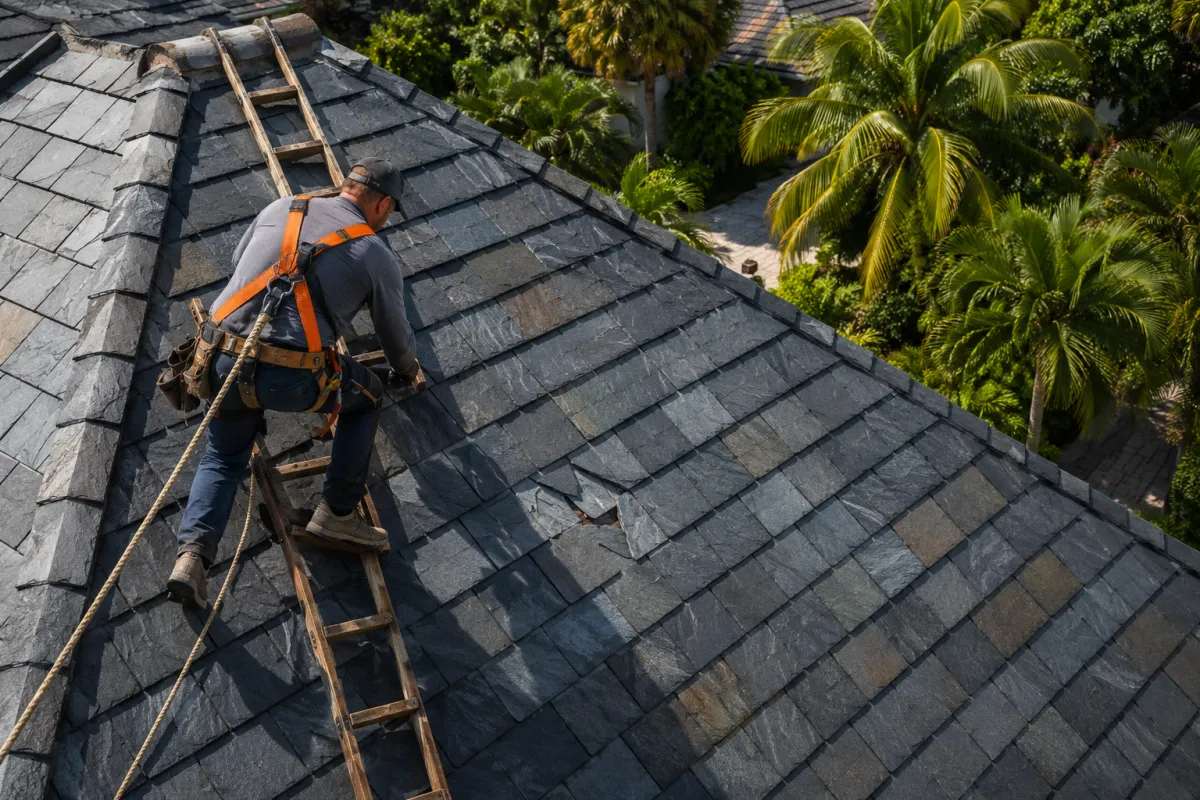
Professionals walk on slate. They do it routinely. The reason it works for us and not for the average homeowner is not bravery or balance. It is equipment, training, and the willingness to slow down.
We tell every client the same thing. If we cannot walk it safely with the right gear on a dry day, nobody should be walking it at all.
Specialised Equipment We Use
Our crews never step directly on slate without something between the foot and the tile.
The standard tools include hook ladders, also called chicken ladders, which are wooden frames that hook over the ridge of the roof and distribute weight along their full length rather than concentrating it on a single tile. Foam pads and walk boards do the same thing on a smaller scale, spreading body weight across multiple tiles so no single tile takes the full load.
Roof anchors and harness systems handle the fall protection side of the equation. These get installed at the ridge and connect to a rope and harness so a slip does not become a ten foot drop. For routine inspections, we increasingly use drones. A good drone inspection captures every tile, every flashing, and every valley without anyone ever touching the roof. That is the safest possible inspection there is.
Proper Footwear and Foot Placement
Soft soled rubber shoes only.
No work boots. No hiking boots. No hard soled anything. The harder the sole, the more force concentrates onto the slate when you step. Our crews wear flexible rubber soles that grip slightly and spread the load across a wider area of the tile.
Foot placement matters just as much as footwear. The structurally strongest part of any slate tile is the lower third, where it overlaps the row of tiles below it. That overlap is supported by the tile underneath, not just by a nail. Stepping there transfers force to the supported area. Stepping in the centre of an exposed tile transfers force to the unsupported middle, which is where the cleaving happens. Pros also walk slowly, sideways across the slope rather than straight up or down, which keeps the load balanced.
When and Why We Will Not Walk on It
We turn down jobs.
If the slate is wet, we wait. If a storm is coming, we reschedule. If the roof shows extensive damage and walking it would clearly cause more, we use a lift, scaffolding, or a drone. We have walked away from inspections that other contractors would have charged for, because walking that particular roof on that particular day was not worth the risk to our crew or to the homeowner's tile.
A roofer who climbs onto your slate without checking the weather is not someone you want on your roof.
Florida-Specific Concerns for Slate Roof Owners
Almost every article about walking on slate roofs is written for cold climates. Snow, ice, freeze thaw cycles, that whole vocabulary.
Florida is a different planet.
Slate roofs in Hialeah, Miami, and West Palm Beach face challenges that homeowners in the Northeast never encounter. Hurricane wind loads, year round humidity, salt air near the coast, and code requirements that change how every repair has to be done. If you are thinking about climbing your slate roof in South Florida, the local conditions matter as much as the slate itself. Our guide on how to protect your roof from hurricane damage covers the storm side of this in more detail.
Post-Hurricane Slate Roof Inspections
The temptation is huge.
A hurricane passes, the sun comes out, you want to know if your slate roof made it. We get the call within hours of every named storm. The honest answer is that the period right after a hurricane is the worst possible time for a homeowner to climb a slate roof. The tiles that survived may be loose. Wind driven debris may have created cracks invisible from below. Wet slate combined with debris on the surface turns walking conditions into something even our trained crews approach carefully.
Professional post storm inspections involve a ground level visual check first, then a drone flyover, and only then a physical inspection if the first two reveal something that requires hands on assessment. Most of what homeowners are worried about can be confirmed without anyone setting foot on the roof.
Humidity, Moss, and Algae Buildup
Florida humidity does to slate what salt does to a car.
Moss and algae thrive in shaded sections of any slate roof in South Florida, especially on the north facing slopes that never get direct sun. That biological growth holds moisture against the slate, accelerates wear, and creates the slick film that turns walking conditions dangerous. According to the EPA's WaterSense data, sustained humidity above 60% supports continuous algae growth, and South Florida averages 70 to 80% humidity year round.
Regular professional cleaning prevents both the biological damage and the walking risk. We use soft wash techniques specifically because power washing breaks slate. The same chemistry that kills moss without harming the tile also restores grip to the surface.
Miami-Dade Code Compliance and Insurance Implications
This is the part most homeowners do not think about until it is too late.
Miami-Dade County operates under HVHZ, the High Velocity Hurricane Zone, which means every roofing repair in our service area has to meet some of the strictest code standards in the United States. A DIY repair on a slate roof, even one that looks fine, may not meet those standards. If a storm later exposes that repair as non-compliant, your insurance carrier has grounds to deny the claim.
We have been licensed under CGC1531617 for years and have completed thousands of code approved roofing projects across Hialeah, Miami-Dade, Broward, and Palm Beach counties. Every repair we do passes inspection because it has to. That is the standard we work to.
When to Call a Professional Instead of DIY
There is a simple way to think about this.
If the question "should I climb up there myself" has even crossed your mind, the answer is probably no. The cost of a professional inspection is small. The cost of getting it wrong is enormous. Book the inspection.
You can get a free estimate from G&R any day of the week, and we have technicians serving every neighbourhood from Hialeah to West Palm Beach.
Signs You Need a Professional Right Now
Some situations are not optional.
Visible damage. If you can see cracked, slipped, or missing tiles from the ground, the roof needs attention now, not at your next convenience. Each day that passes lets water work deeper into the underlayment.
Water stains on interior ceilings. A stain means water has already breached the roof and saturated insulation, drywall, or wood. By the time the stain shows up, the leak has been active for days or weeks.
After any major storm event. Hurricanes, tropical storms, and severe thunderstorms all damage slate in ways that may not be visible from below. A post storm inspection catches problems before they become emergencies.
Roof is older than 25 years and has never been inspected. Even hard slate that lasts 150 years needs the flashing, valleys, and underlayment checked periodically. These supporting components fail long before the slate itself does.
What a Professional Slate Roof Inspection Includes
You should know what you are paying for.
A real slate roof inspection starts with a ground level visual assessment, identifying obvious damage, missing tiles, and biological growth. The next step is either a ladder based eaves inspection or a drone flyover, depending on roof complexity and weather. If physical access is required, the technician uses chicken ladders and proper PPE. The inspection covers the slate itself, the flashing around chimneys and vents, the valleys where two roof slopes meet, the gutters, and visible underlayment from inside the attic.
The deliverable is a written report with photos and clear recommendations. Cost typically runs $100 to $400 depending on roof size and complexity. Compare that to even a single cracked tile repair and the math is obvious.
Considering an Alternative? Slate-Look Roofing for Florida Homes
Some homeowners reach a different conclusion after living with a slate roof for a few years.
They love the look. They are tired of the maintenance, the inspection costs, the worry every time a storm rolls through, and the fact that nobody can ever climb up there. If that sounds familiar, you are not alone, and you have real options. Modern roofing systems can give you the slate aesthetic without the foot traffic problems, the weight problems, or the repair costs.
We install three categories of slate alternative across Hialeah and South Florida.
Premium Slate-Look Systems
Our slate roof installation line is engineered specifically for Florida homes. The system delivers the same high end appearance as natural slate while meeting Miami-Dade HVHZ wind ratings, supporting safer foot traffic during maintenance, and dramatically reducing the structural reinforcement most older homes need to support real slate.
The visual difference is minimal. The practical difference is significant.
Metal Roofing That Mimics Slate
Modern metal roofing has changed completely from what most homeowners remember.
Today's panels can mimic slate, shake, or tile while weighing a fraction of the natural material. Our metal roof installation is lightweight, energy efficient, walkable for routine maintenance, and rated for hurricane force winds. Metal roofs reflect heat, which matters in South Florida where cooling costs run year round, and they last 50+ years with minimal upkeep.
For homeowners who want longevity without fragility, metal is hard to beat.
Tile Roofing as a Florida-Friendly Alternative
Concrete and clay tile have been the South Florida default for a reason.
Our tile roof installation combines classic Florida aesthetics with fire resistance, hurricane performance, and a maintenance profile that fits the local climate. Tile is heavier than metal but lighter than slate, more forgiving of foot traffic than natural slate, and available in styles that range from Spanish barrel to flat profile that approximates the slate look.
Every roof we install is inspected and approved by local building authorities. Every project carries our 5-year parts and labour warranty. And every quote is free, written, and guaranteed with no hidden fees.
Conclusion
Walking on a slate roof is technically possible, but the math almost never works out in your favour. One cracked tile costs more than a full professional inspection, and one fall costs more than your entire roof.
This is not a decision to put off until next storm season. South Florida's hurricane window opens every June, and slate roofs that go uninspected through one storm cycle often need major repairs by the next.
At G&R Doors, Windows & Roofing, we offer free, no obligation slate roof inspections, drone assessments, and complete repair or replacement services backed by a 5 year parts and labour warranty. Every project is HVHZ code compliant and licensed under CGC1531617.
Stop wondering. Stop climbing. Get your free slate roof inspection and let our team handle it safely.
FAQ
Q1: Is it safe to walk on a slate roof when it's wet?
Answer: No, wet slate becomes extremely slippery. Even professionals avoid wet conditions because the fall risk is too high. Florida's frequent rain and humidity make this especially dangerous.
Q2: How much does it cost to replace a single broken slate tile?
Answer: $75–$250 per tile, depending on slate type and accessibility. Major repair projects can reach $20,000 if multiple tiles are damaged or flashing needs replacement.
Q3: What shoes should you wear if you must walk on a slate roof?
Answer: Soft-soled rubber shoes, never boots or hard-soled work shoes. The softer the sole, the better the grip and the less pressure transferred to the slate.
Q4: How can you inspect a slate roof without walking on it?
Answer: Use a ladder to inspect from the eaves, hire a professional with drone equipment, or use binoculars from the ground. Most modern Florida roofing companies offer drone inspections that avoid roof contact entirely.
Q5: Does walking on a slate roof void the warranty?
Answer: Often, yes, many slate roof warranties exclude damage caused by foot traffic or unauthorized maintenance. Always check your warranty terms before climbing up, and use only certified roofing professionals for any work.
