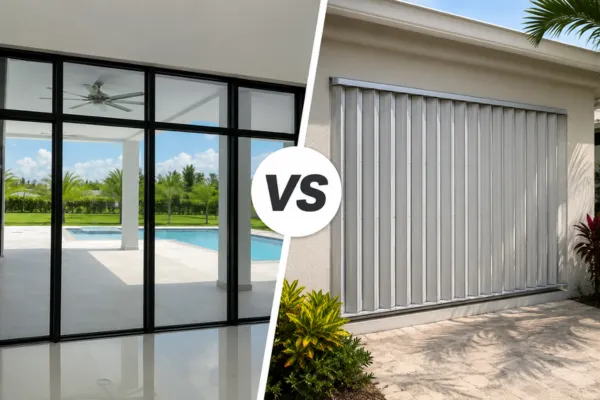
Impact Doors vs Hurricane Shutters: Which Protects Better?
When a hurricane heads for South Florida, your doors are one of the first places wind and debris try to force their way in. Two proven ways to protect them are impact doors and hurricane shutters. Both meet Florida code when properly approved, and both stop wind-borne debris. The real difference is how they protect: a hurricane-rated impact door is permanent and always working, and you can still open and close it during a storm, while hurricane shutters are a removable barrier you put up over the opening before each storm at a lower upfront cost.
At G&R Doors, Windows & Roofing, homeowners ask us this every hurricane season, especially about the main entry and patio doors they use daily. Here is an honest, side-by-side look so you can choose what fits your home, your budget, and how you live.
Quick overview:
Both impact doors and hurricane shutters meet the Florida Building Code when properly approved and installed
Impact doors are permanent, always protecting, and keep the doorway usable, while adding insulation, noise reduction, and security every day
Hurricane shutters cost less upfront but must be deployed before each storm, and a covered door usually cannot be used
Both qualify as opening protection for wind mitigation insurance credit
The best choice depends on your budget, the opening, and how hands-off you want protection to be
Impact Doors vs Hurricane Shutters: The Quick Answer
For a door you use every day, impact doors usually protect better in practice, because the protection is always on and the door still functions during a storm. Hurricane shutters protect the same opening for less money, but only once you deploy them, and the door behind them is blocked while they are up.
Neither option is "wrong." A properly approved shutter and a properly approved impact door both satisfy Florida's opening-protection requirement. The question is which trade-offs make sense for your home.
How Impact Doors Work
An impact door is built as a complete system. The glass is laminated, meaning two panes are bonded to a tough inner layer that holds together even when it cracks. The frame is reinforced, the hardware uses multipoint locks, and the whole unit is engineered to resist both flying debris and the sustained wind pressure of a hurricane.
To be sold for storm protection in Florida, impact doors are tested to national standards, ASTM E1886 and ASTM E1996, which simulate a large missile strike and repeated wind-pressure cycles. Products that pass carry documentation such as a Florida Product Approval number or a Miami-Dade Notice of Acceptance, which is the paperwork your building department and insurer look for.
Because the protection is built in, there is nothing to deploy. The door defends your home 24 hours a day, and you keep using it normally. Even impact glass can chip from a hard strike, but the door is designed not to breach, which is what keeps wind and water out of the house.
How Hurricane Shutters Work
Hurricane shutters are a separate barrier that covers the opening during a storm. They come in several types:
Storm panels: removable aluminum or polycarbonate panels installed over the opening before a storm and stored afterward. The most affordable option, and the most labor each time.
Accordion shutters: permanently mounted, they fold out from the sides and lock in the middle. No storage needed, quick to close.
Roll-down shutters: mount above the opening and roll down when needed. Manual or motorized, with motorized versions closing at the push of a button. The most convenient, and the priciest shutter type.
Bahama and colonial shutters: decorative styles that double as storm protection when rated and closed.
Like impact doors, shutters sold for storm protection in Florida must carry a Florida Product Approval number or a Miami-Dade NOA. Approved shutters pass the same kind of large-missile and cyclic-pressure testing. The difference is that a shutter only protects once it is closed over the door.
Impact Doors vs Hurricane Shutters: Side-by-Side
Cost: Impact Doors vs Hurricane Shutters
On the sticker, hurricane shutters usually win. Storm panels are the least expensive way to protect an opening, accordion shutters sit in the middle, and motorized roll-downs are the priciest shutter option. An impact door is a larger one-time investment because you are replacing the whole door, not adding a cover to it.
The fuller picture includes time and daily value. Shutters carry a recurring cost every storm season: the hours to put panels up and take them down, and the storage in between. Impact doors have no per-storm effort, and they work for you year-round through lower energy bills, quieter rooms, and better security. For a door you use daily, that everyday value often closes the gap over time.
Exact pricing depends on the door type, size, material, and your opening, so the honest answer is to get a quote for your specific project rather than rely on a generic number.
Convenience, Safety, and Daily Living
This is where doors differ from windows, and where the comparison gets practical. With shutters over an exterior door, that door is generally out of use while they are up. That matters most for the doors you rely on to enter and exit.
Miami-Dade County's own hurricane guidance makes the point directly: once doors are shuttered or boarded, it is harder to get out in an emergency, so every household should know its available exits. Impact doors avoid that problem, because the doorway keeps working the entire storm. If you have limited mobility, travel during the season, or simply do not want to deploy anything before a storm, a permanent impact door is the hands-off choice.
Do Impact Doors and Shutters Meet Florida Code?
Yes, both can. In Florida's Wind-Borne Debris Regions, and especially in the High-Velocity Hurricane Zone that covers Miami-Dade and Broward, every exterior opening must have approved protection. You can meet that requirement with an impact-rated door or with approved hurricane shutters over a standard door. Either path is code-compliant when the product carries a valid Florida Product Approval or Miami-Dade Product Control NOA, and when it is permitted and installed correctly.
You can verify the standards through the Florida Building Code and review hurricane opening-protection guidance from Miami-Dade's emergency preparedness resources. For a deeper look at how these choices play out across your whole home, our guide on impact windows vs hurricane shutters covers the window side of the same decision.
Which Should You Choose?
Impact doors make more sense when:
The door is a main entry or patio door you use daily
You want permanent, hands-off protection with nothing to deploy
You value everyday insulation, noise reduction, and security
Your HOA restricts visible shutter hardware
You may not be home when a storm arrives
Keeping the doorway usable during a storm matters to you
Hurricane shutters make more sense when:
Your budget is tight and you need protection now
You are covering a rarely used opening
Your existing door is in good shape and you do not want to replace it
You want a removable barrier or an extra layer over other protection
Some homeowners use both, adding shutters over impact doors for a second layer in the strongest storms. For most homes, though, a properly rated impact door protects the opening well on its own and meets code without shutters.
Do You Still Need Shutters If You Have Impact Doors?
No. A Florida-approved or Miami-Dade NOA impact door satisfies the opening-protection requirement by itself, so you are not required to add shutters over it. Layering the two is a personal choice for extra peace of mind, not a code obligation.
Frequently Asked Questions
Q1. Are impact doors better than hurricane shutters?
Answer: For doors you use daily, impact doors are often the better fit because protection is always active, the door stays usable during a storm, and you get year-round benefits. Shutters are a strong, lower-cost option that protect the same opening once deployed.
Q2. Are hurricane shutters cheaper than impact doors?
Answer: Usually yes, at least upfront. Storm panels and accordion shutters cost less than replacing a door with an impact-rated unit. Motorized roll-downs narrow that gap. Remember to factor in the time to deploy shutters each storm and the daily value an impact door adds.
Q3. Which is easier, impact doors or hurricane shutters?
Answer: Impact doors, by a wide margin. There is nothing to install before a storm and nothing to store afterward. Among shutters, motorized roll-downs are the easiest, while storm panels take the most effort each time.
Q4. Which helps with insurance more?
Answer: Both qualify as opening protection on Florida's wind mitigation inspection, so both can earn a credit. The exact discount depends on your insurer and on protecting all openings. A wind mitigation inspection after installation documents the upgrade for your carrier.
Q5. Do I still need shutters if I have impact doors?
Answer: No. An approved impact door meets the opening-protection requirement on its own. You can add shutters for a second layer if you want, but it is not required.
The Bottom Line
Impact doors and hurricane shutters are both real hurricane protection, and both meet Florida code when properly approved and installed. Shutters cost less at the start and suit rarely-used openings or tighter budgets. Impact doors cost more upfront but protect around the clock, keep the doorway usable, and pay you back every day in comfort and security, which is why so many South Florida homeowners choose them for the doors they use most.
If you want protection you never have to think about, we can help you compare Miami-Dade approved impact doors for your home. Request a free impact door estimate and we will walk you through the options, the approvals, and the paperwork.
